
How to Simplify Your Closet With a Winter Capsule Wardrobe
Have you ever opened your closet on a cold winter morning and somehow felt like you had nothing to wear? There may be sweaters stacked on every shelf, coats taking over the hanging space, and shoes gathered by the door, yet getting dressed still feels harder than it should.
A minimalist closet can change that feeling without requiring you to own only ten pieces of clothing. The goal is not to make your wardrobe look empty. It is to make it easier to see what you actually wear, what works together, and what deserves the space it takes up.
A winter capsule wardrobe is a practical way to get there. Instead of starting with a strict number of pieces, think about creating a small collection of dependable clothes that suit your real winter days. Work mornings, grocery runs, weekends at home, coffee with a friend, and those unexpectedly mild afternoons all count.
The nicest part is that simplifying your closet does not have to happen in one dramatic afternoon. You can make thoughtful changes gradually and still end up with a simple wardrobe that feels comfortable, personal, and easy to live with.

Start With the Clothes You Actually Wear
The easiest place to begin building a minimalist closet is not the shopping list. It is your existing wardrobe.
Before taking everything out of the closet, spend a few ordinary days paying attention to what you naturally reach for. Maybe it is the same straight-leg jeans, a soft knit sweater, one warm coat, and a pair of boots that somehow work with almost everything. Those pieces are giving you useful information.
A common mistake when people declutter wardrobe collections is deciding what should stay based entirely on an imagined lifestyle. That beautiful wool skirt might look perfect in theory, but if you spend most winter days in jeans and comfortable trousers, it may not need prime real estate in your closet.
Try a simpler question: Would I realistically choose this on a normal winter morning?
If the answer is yes, put it in your everyday group. If you love the item but rarely wear it, place it in a separate group rather than immediately getting rid of it. This keeps the process practical instead of emotional.

This is also where you begin to notice patterns. Perhaps nearly all of your favorite outfits use the same three colors. Maybe you prefer relaxed trousers to skirts, or ankle boots to tall boots. These details are more valuable than a generic capsule wardrobe checklist because they tell you what actually works for you.
A minimalist closet should reflect your life rather than someone else’s version of minimalism.
If your fall wardrobe already has pieces you love, you may not need to start over for winter. A helpful next step is to see how those existing pieces can work through colder weather. Our guide on How to Transition Your Fall Capsule Wardrobe into Winter can be a useful companion when you are deciding what should stay in rotation.
Build Your Winter Capsule Around Real Outfits
Once you know which clothes you actually wear, start thinking in outfits rather than individual pieces.
This small shift can make a surprisingly big difference. Instead of asking whether you have enough sweaters, ask whether your sweaters work with your trousers, jeans, coats, and shoes. A winter capsule wardrobe becomes much easier to manage when most of its pieces can move between several outfits.
For example, imagine your everyday winter base is a pair of dark straight-leg jeans, black trousers, and relaxed blue denim. Add a cream knit, a gray sweater, a striped long-sleeve top, and a slightly dressier cardigan. Now introduce one warm coat and a casual jacket. Suddenly, you have several combinations without needing a closet full of options.
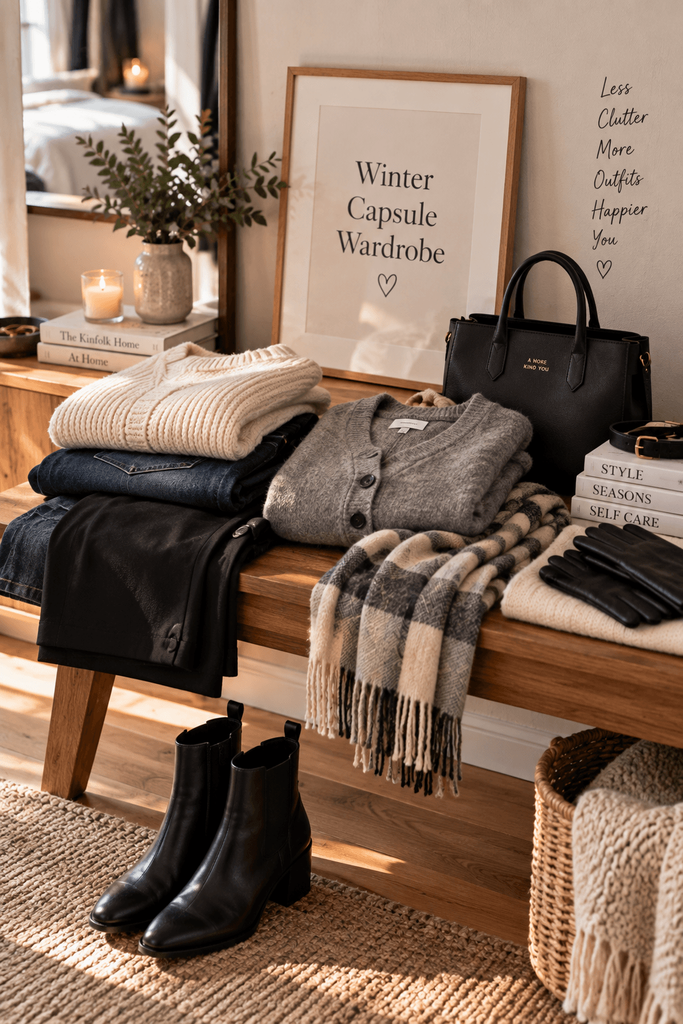
The same idea works with accessories. One textured scarf can change the feeling of a familiar coat. A structured handbag can make jeans and a sweater feel more polished. A pair of simple boots can work with both trousers and casual denim.
This is why a simple wardrobe does not necessarily mean boring clothes. It means choosing pieces that can participate in more than one outfit.
You also do not need every item to be neutral. If burgundy, forest green, navy, or soft blue makes you happy in winter, include it. A capsule wardrobe should have enough personality that you still enjoy opening the closet.
One useful rule is to identify three categories:
Everyday essentials: the clothes you wear repeatedly.
Layering pieces: sweaters, shirts, cardigans, and lighter tops that create combinations.
Personality pieces: colors, patterns, textures, or accessories that make the wardrobe feel like yours.
When these groups work together, getting dressed becomes less about searching and more about choosing.

Declutter Without Making Your Closet Feel Empty
Decluttering your wardrobe can feel surprisingly personal. Clothes often carry memories, hopes, or versions of ourselves that we once wanted to become. That is why a minimalist closet does not have to mean immediately removing anything that does not fit into a neat capsule.
Instead, create some breathing room.
Start with the easiest decisions. Remove clothes that are damaged beyond repair, uncomfortable every time you wear them, or clearly unsuitable for your current lifestyle. These decisions usually require less thought.
Then move toward the more complicated pieces.
Perhaps you have a beautiful sweater that you love seeing but never actually wear. Maybe there is a coat that looked wonderful in the store but does not work with the clothes you own. Or perhaps you have five nearly identical black tops when you consistently reach for the same two.

Instead of asking, “Is this good enough to keep?” try asking, “Does this make my everyday wardrobe easier?”
That question is particularly helpful when you are trying to create a simple wardrobe. An item does not have to be fashionable, expensive, or versatile enough for ten outfits to deserve a place. It simply needs to have a useful role in your life.
For uncertain pieces, create a temporary holding space. Put them in a box or separate section for a few weeks. If you repeatedly look for them, you have your answer. If you forget they exist, you may have found the easiest category to let go.
There is also no need to declutter everything in one weekend. One drawer today, the coat section tomorrow, and the shoe shelf next weekend can be much more manageable.
The result should not feel like you have stripped your personality from the room. It should feel like the clothes you love are easier to find.
Make Winter Layers Work Harder
Winter is where a minimalist closet can sometimes become difficult because clothing needs to perform several jobs at once. You need warmth, but you also want outfits that do not feel bulky. You may need clothes for work, errands, weekends, and occasional dinners without owning separate wardrobes for each situation.
Layering solves much of this.
Think of your winter wardrobe as a series of flexible layers rather than a collection of complete outfits. A fitted long-sleeve top can sit underneath a cardigan. A button-down can work beneath a sweater. A wool coat can finish jeans just as easily as tailored trousers.

This approach also helps you identify gaps before buying anything. If you have plenty of sweaters but almost nothing lightweight enough to wear underneath them, the problem may not be that you need another sweater.
You may simply need a couple of good base layers.
The same applies to outerwear. A warm everyday coat might cover most situations, while a lighter jacket can be useful during transitional weather. Scarves, hats, and gloves then add warmth without requiring another complete outfit.
When you are building a minimalist closet, look for pieces that solve several small problems. A cardigan that works at home and at work is more useful than one that only suits a particular occasion. A pair of boots that feels comfortable enough for errands but polished enough for dinner will naturally earn more wear.
And remember that winter clothes are often worn repeatedly. There is nothing wrong with repeating an outfit you genuinely like.
In fact, outfit repetition is one of the quiet advantages of a simple wardrobe. When your clothes work well together, repeating your favorite combinations feels effortless rather than limiting.
Give Your Closet a Simple Winter Rhythm
Once your winter capsule wardrobe is assembled, resist the temptation to keep reorganizing it.
A closet does not need to look perfect every day. Real clothes are worn, washed, folded, hung up, and sometimes left on a chair overnight. A useful minimalist closet should be easy enough to maintain when life gets busy.
One simple habit is to keep your most-worn winter clothes at eye level. Put everyday sweaters, jeans, and trousers where you can see them easily. Less frequently worn occasion pieces can move higher or farther back.

You can also create a small “ready to wear” section. It might contain a few combinations you know work well: jeans with a cream sweater, black trousers with a cardigan, or denim with a striped top and wool coat.
This is particularly helpful on mornings when you are short on time.
If you enjoy seasonal resets, keep the process gentle. At the beginning of winter, bring forward the pieces you will actually use and move obvious summer items elsewhere. At the end of the season, notice what you wore repeatedly and what stayed untouched.
Those observations make the next season easier.
You may discover that you need fewer clothes than you thought, but you may also discover that one category deserves more attention. Perhaps you genuinely need another pair of warm trousers. Perhaps your coat collection is fine but your sweaters need replacing.
The point is not to reach a perfect number. It is to understand your own wardrobe well enough that buying becomes more intentional.
If you want to explore this idea further, The Minimalist Winter Wardrobe That Makes Getting Dressed Easy fits naturally with this process. It takes the same general idea one step further: creating a winter wardrobe that feels uncomplicated without becoming overly restrictive.

Let Your Closet Become Easier, Not Smaller
There is something satisfying about a closet where your favorite clothes are visible.
You open the door and immediately recognize the sweater you wanted. Your boots are easy to reach. Your coat works with the trousers hanging underneath it. You are not moving five unworn pieces aside just to find the jeans you wear every Tuesday.
That is the real appeal of a minimalist closet.
It is less about owning as little as possible and more about reducing the amount of friction between you and the clothes you already enjoy. A winter capsule wardrobe simply gives that idea a seasonal structure.
You can start small. Choose five pieces you wear constantly. Build a few outfits around them. Remove one category of clothing that no longer serves your everyday life. Then leave the closet alone for a week and see how it feels.
You may find that the best wardrobe is not the one with the fewest pieces. It is the one where the right pieces are easy to see, easy to combine, and genuinely enjoyable to wear.
And once your closet starts working that way, getting dressed on a cold winter morning can become a much quieter part of the day.


